Zephr is in maintenance mode. You have a renewal decision to make.
The entire founding team left in February 2026 to launch MonetizationOS. Zuora’s Q2 release notes mention Zephr zero times. If you’re a Zephr customer, you’re paying enterprise prices for a product nobody is building.
This page walks through what staying costs, what switching looks like, and an honest list of alternatives (including the ones that aren’t us).
What’s actually happening at Zephr
The timeline tells the story. Zuora acquired Zephr for $44 million in September 2022. Zuora itself went private with Silver Lake and GIC in a $1.7 billion deal in February 2025. Then in February 2026, the Zephr founding team (James Henderson, Ben Kennedy, Jamie Walker, Courtney Jarret, James Leach) walked out to start MonetizationOS, with Google and Cloudflare backing.
A subscription experience platform sitting inside a billing company, with no founders and no new investment.
If you’re running Zephr today, you already feel this. Support takes longer. Roadmap calls dried up. The feature requests you logged 18 months ago haven’t moved.
What staying costs
The renewal fee is the obvious cost. The hidden costs are bigger.
- No roadmap. The product vision lives at a different company now.
- A bot problem your vendor isn’t visibly addressing. Per the 2025 Imperva Bad Bot Report, 51% of web traffic is now bots, most of it AI-driven scraping. Whether Zephr ships new defenses is a question, not a given.
- Pricing locked to your last contract. Enterprise contracts don’t get cheaper because the product stopped improving.
- Support queued behind a bigger book of business. Where publisher tickets land in Zuora’s queue is Zuora’s call, not yours.
- Subscriber data on third-party servers. When you eventually move (and you will), getting that data out is a project.
Those costs compound quarter over quarter. In the AI age, no decision is a decision.
Why you haven’t left yet
It’s not the renewal fee keeping you on Zephr. It’s the migration.
A replatform sounds like months of engineering, broken renewals, angry subscribers, and a data export your vendor has no incentive to make easy. Weighed against that, another year of maintenance mode feels safe.
Looking to grow your publication?
Sign up for expert advice straight to your inbox.We’ve spent a decade migrating publishers off platforms that stopped serving them, and the fear is consistently bigger than the project. Switching to Leaky Paywall takes a day to a week for most publishers. The Olive Press was live in days: “Leaky Paywall migrated us in days. Everything works. Support is instant, and our subscribers have skyrocketed.”
Here’s the principle underneath it: you shouldn’t have to negotiate with a billing company to get your own subscribers back.
What switching actually looks like
Three steps. You control the pace.
1. Map the migration. We start with a Zoom call and blueprint your setup: subscriber tiers, payment gateways, gating rules, print circulation, integrations. You’ll know the full scope before anything moves.
2. We move everything. Subscriber import into WordPress (your readers become users in your own database, no vendor between you and your records). Payment gateways you already use: Stripe (we’re a Verified Partner), PayPal, Authorize.net, Xendit, plus 100s more via WooCommerce. Your existing billing relationships come with you. Print circulation handoffs to simplecirc, Omeda, Darwin CX, MagHub, SFS, and others are built in.
3. Launch and grow. Your gating rules (metered, hard, registration wall, hybrid by category, tag, or post type) get configured inside the WordPress admin, not behind a rule engine you need a developer to interpret. Then we set up the growth system Zephr never gave you.
The system you get after the switch
Here’s the stat that should reframe the renewal decision: 70% of publishers grew subscription revenue in the past year even as traffic declined (Piano, April 2026). Same report: engaged readers generated 110 times more revenue than casual ones.
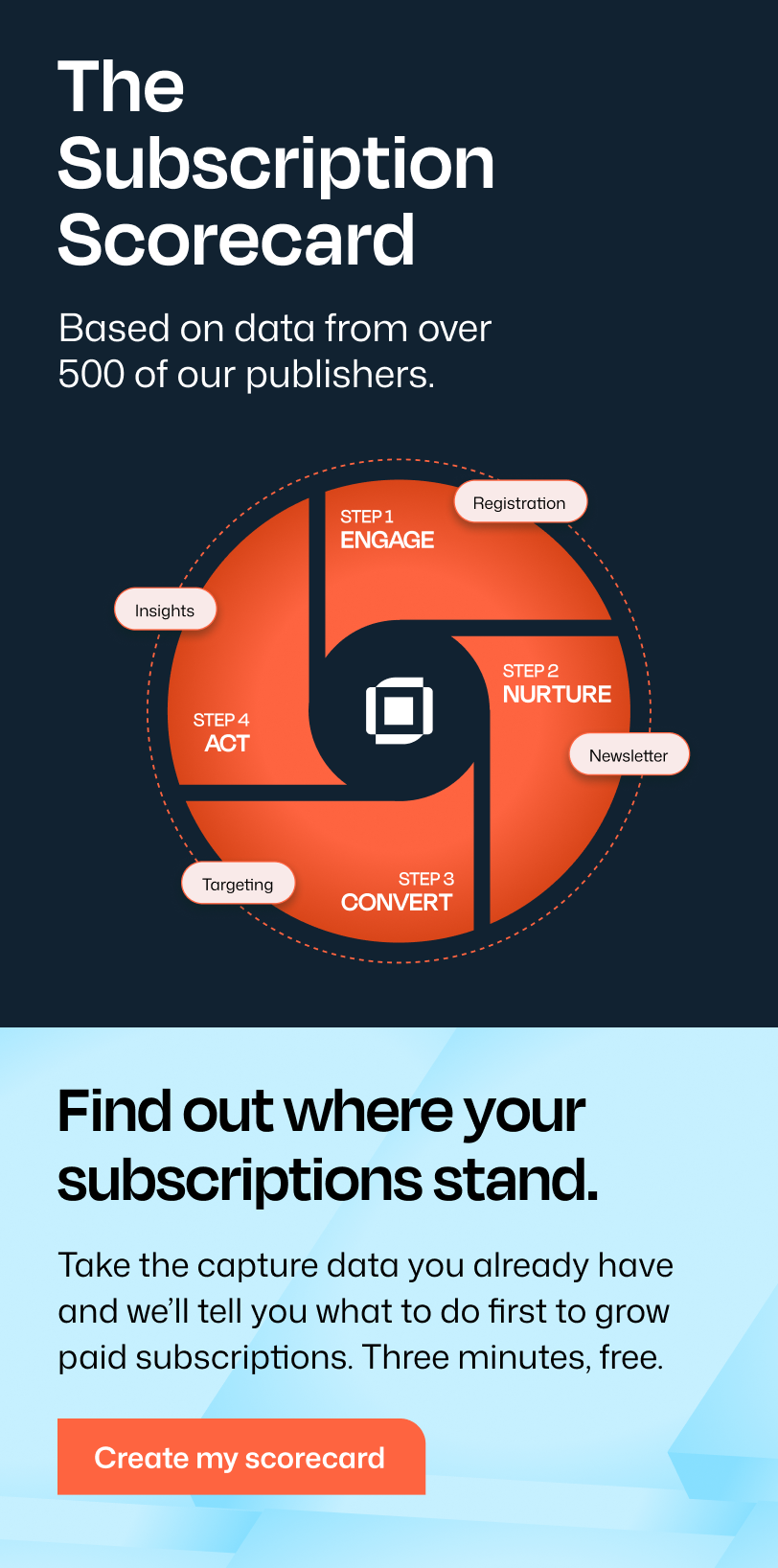
The publishers who grew stopped optimizing the paywall and started optimizing the reader journey. That’s the Publisher Flywheel.
- Free registration captures readers who aren’t ready to pay. Their email is worth more than their first paywall view.
- Email becomes the conversion channel. Casual visitors convert at about 1%. Engaged email subscribers convert at 10 times that or more.
- Targeted offers replace generic discount blasts. The reader on your site three times this week gets a different pitch than the one who came in cold.
- Retention runs as its own discipline, on the same data stack.
Bloomberg-sized publishers stitch this together inside Zephr with identity, decisioning, and entitlements. A WordPress publisher runs it inside Leaky Paywall without the enterprise contract.
Small Boats Magazine added a free registration wall with List Builder and grew their email list 20% per month. Mexico News Daily streamlined the reader journey on WordPress and grew from under 500K to 1.4 million monthly visitors while paid subscriptions climbed.
One more thing Zephr isn’t shipping: AI defenses. Leaky Paywall includes AI scraper blocking and incognito blocking in the same product that runs your subscriptions. Your registration wall doubles as a bot wall. That’s one stack handling both problems instead of two.
Alternatives to Zephr worth evaluating
Four options that come up consistently in switching conversations:
Leaky Paywall is the WordPress-native option. Free to start, with List Builder, AI scraper protection, and Stripe Connect billing in the free tier. Powers 800+ publishers including Mexico News Daily and Small Boats Magazine. Best fit if you’re running WordPress and want subscriber data inside your own CMS.
Piano is the closest direct enterprise alternative. The company named Nick Worth CEO in April 2026 and continues to ship product updates. Best fit for very large publishers with dedicated subscription engineering teams and the budget that comes with that.
Pelcro is the mid-market headless SaaS option. The team has been actively shipping recently, including OAuth2 and Braintree integrations. Best fit for publishers running custom front-ends who want a paywall API rather than a CMS plugin.
Memberful is the simpler option, now owned by Patreon. Less news-publisher-specific than the others. Best fit if you’re a smaller publication that doesn’t need the full enterprise feature set.
A note on MonetizationOS
The Zephr founders’ new company is pitched at edge-native infrastructure for monetizing bot and AI agent traffic. That’s a real problem. It’s not the same problem as converting human readers into paid subscribers.
If you’re running a publisher subscription business, the question in front of you is how to turn casual visitors into paying readers. That’s a paywall and reader-journey question, not an edge infrastructure question.
Bottom line for Zephr publishers
The cost of staying compounds quarter over quarter. The cost of moving is one project that takes a day to a week.
If your contract is up for renewal this year, put this question in front of your team: are we paying for innovation, or are we paying for inertia?
Ready to see the scope? Book a migration call – we’ll blueprint your move before you commit to anything.
Not ready to talk? Grab the free AI Survival Guide at publisherrevenue.com. It’s the first-party data behind the Publisher Flywheel, from 500+ publishers, plus the 90-day plan to install it.