Two publishers tried to fix their email costs this month. One deleted 30,000 contacts. The other cut their daily newsletter to weekly. Both shot themselves in the foot. Within weeks, paid signups started softening. The savings? Maybe $300/month on email. The damage? Roughly $15,000 a year in lost subscription revenue. This episode breaks down why aggressive email list cleaning is costing publishers right now, and how to fix the cost problem without torching your conversion engine.
Listen to this episode on the Paywall Podcast
Pete sat down with Tyler from Newsletter Glue on the latest Paywall Podcast to break down what’s actually happening when publisher email lists balloon (a good problem) and why the most common reactions make things way worse. They cover the math, the framework, and the front-end and back-end fixes that protect your conversion engine while keeping email costs in check.
Why Aggressive Email List Cleaning Costs Publishers’ subscriptions
Email list growth is up. Way up.
Publishers running List Builder are seeing roughly 5x the signup volume they got from popups and slide-ins. That’s a great problem to have. It also means the MailChimp bill is climbing, and the panic kicks in.
Two real reactions we just watched play out:
- One publisher deleted 30,000 unengaged contacts in one shot
- Another cut their daily newsletter cadence to weekly to save on sends
Both saw paid signups soften within weeks. Why? Because the free registered list IS the conversion engine. Cut the volume, cut the touches, cut the conversions.

The math is brutal. Saving $300/month on email sounds like a win until you do the second calculation. If 1% of those 30,000 readers would have converted at a $50 annual sub, you just torched $15,000 in recurring revenue to save $3,600.
Tyler, Newsletter Glue“The amount of money that you’re saving from cutting your email costs, you’re just completely demolishing recurring revenue from those potential new signups.”
Email is the one channel publishers still control. Piano reported a 36% drop in publisher search traffic last year. AI Overviews keep readers on the SERP. Social referrals are a fraction of what they used to be. Cutting email first is cutting your last lever.
Looking to grow your publication?
Sign up for expert advice straight to your inbox.For more on why cutting cadence is the wrong move, read our take on How Often Publishers Should Send Newsletters.
Clean Smart Without Killing Your Conversion Engine
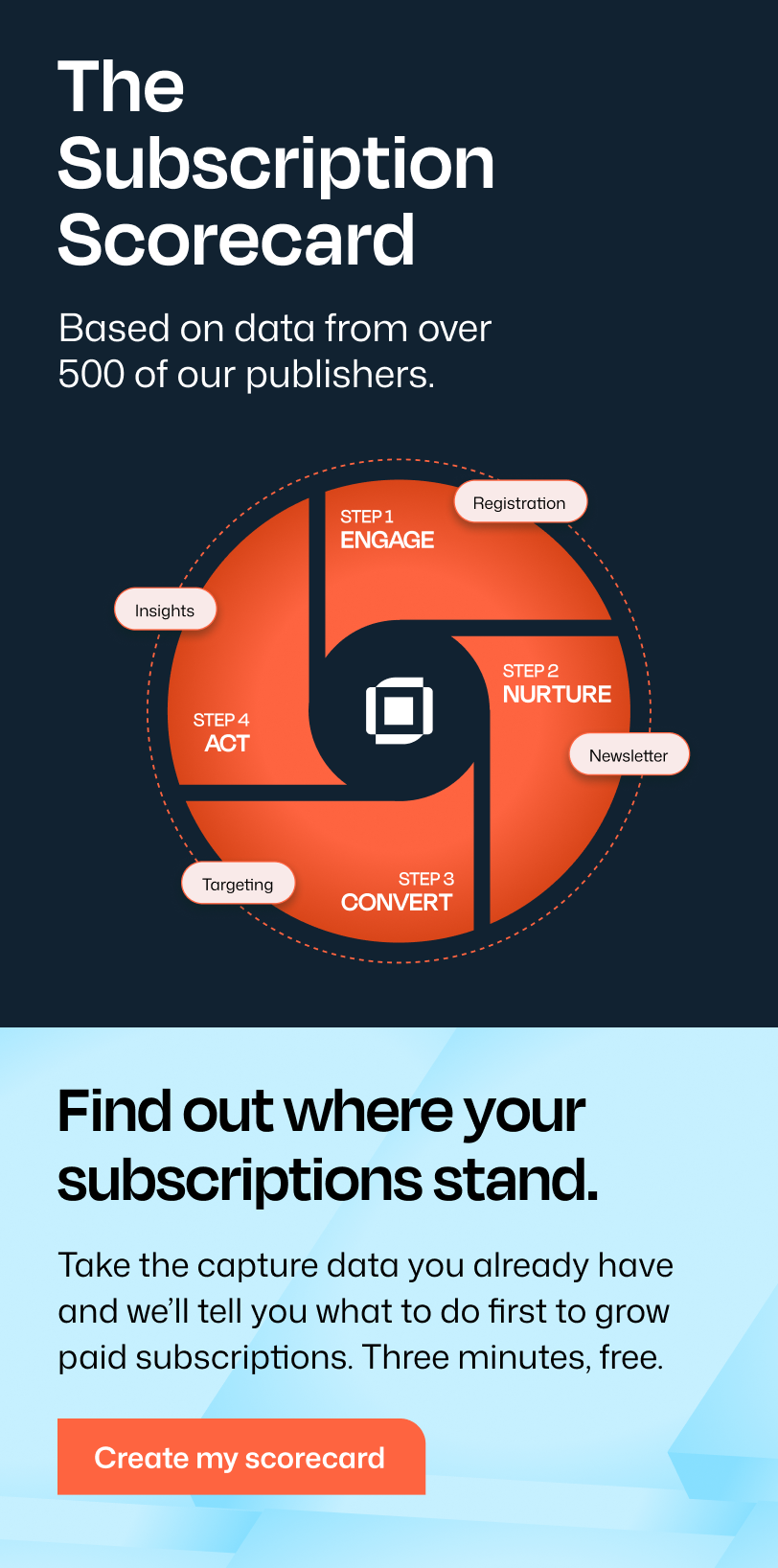
Your free registered list is your highest-leverage pipeline for paid conversions. The flywheel is simple: registration captures the email, the newsletter pulls readers back to your site, and the site shows the upgrade message. Most readers need to see that message 10-20 times before they convert.

Cut the email volume, and the whole loop slows down.
The good news is cleaning your list isn’t a binary delete-or-don’t decision. There are two levers, and they work together: filter junk at the front end so it doesn’t get in, and segment intelligently at the back end so unengaged readers aren’t deleted, just paused.
For the full flywheel framework, see The 3-Step Plan to Grow Your Email List.
The Solution: A Front-End and Back-End Framework for Email List Cleaning
Two halves. Both matter.
Front-End: Stop Fake Email Signups Before They Hit Your List
Most fake email signups can be stopped at the door. Three options, depending on how hard you’re getting hit:
- Password requirement at signup. Asking for a password on registration step two is a quiet, effective filter. Handles roughly 90% of fake-signup cases at zero cost. Most publishers won’t need more than this.
- Email verification. Validates addresses against Gmail and Yahoo databases, blocks profanity emails in real time, no double opt-in friction for the legitimate reader.
- One-time password (OTP). For publishers getting hammered by bots. Reader enters email, gets a 6-digit code, types it back to register. The kicker is technical: the account isn’t created in your system until the code is verified. Bots can hammer the form all day and your subscriber table stays clean.

“Doesn’t pollute your subscriber table. You have a nice clean subscriber. They’re all validated emails.”
Pete
Back-End: Sunset, Don’t Mass Delete
Once readers are on the list, mass-deletion is the wrong tool. Here’s the cleaner workflow:
- Segment unengaged readers (no opens, no clicks over 90 days, however you define it)
- Send 2-3 re-engagement emails asking if they want to stay. A reply request beats a button click
- Move non-responders to a “do not send” segment. Do NOT delete them. Keep them for the next big news moment or major promotion
- Track replies. They’re the gold metric. Gmail watches replies. Your engagement score watches replies. Someone who replies is way more likely to convert than someone who only opens
For more on why replies beat opens as an engagement signal, Dylan Redekop covered it in detail on a previous episode.
One bonus angle worth stealing: revive the letters-to-the-editor format. Ask readers to reply with their take on a story. The replies feed engagement signals AND they become content for your publication. Old-school move that almost nobody does in email anymore.
Your email list is the most valuable asset you own as a publisher. The instinct to slash it when costs go up is understandable, but it’s the most expensive way to save money. Filter junk at the front end, sunset (don’t delete) at the back end, and treat your list like the conversion engine it actually is.