How a Free News Site Hit 5.7% Conversion Without a Paywall
Last updated on Jul 02, 2026
A publisher with roughly 60,000 monthly visitors locks up none of it. Three free articles, then a free registration wall, then unlimited access. No payment is ever required to read. And the readers still pay.
This publisher asked us to keep them anonymous, so we’re leaving out names and identifying details. What we can share is the model, because it works and it runs against almost everything we usually preach.
They sit in a high-density market, covering a niche that the big regional players don’t touch. Tyler from Paywall Project started working with them a few months back, and the early results are strong: a 5.7% registration rate on a wall that gives away three free articles first, plus fast email list growth and real revenue.
A free site that never asks you to pay for content
The setup goes like this. You land on the site off the street and you get three free articles. On the fourth, a free registration wall appears. Hand over an email, create an account, and you get unlimited access to everything, forever. No paid tier sits between you and a single story.
The revenue question is the obvious one, and it’s the first thing we put to Tyler on the episode.
We usually push publishers the other way: crank the meter down to one free article and tighten the wall. Three free reads up front plus unlimited access on the back end runs against everything we preach if revenue is the goal. It works anyway. The money was never going to come from a locked article here. It comes from membership.
The money comes from membership, not gated content
The content stays free. The money comes from everything wrapped around it. This publisher runs a nonprofit-style model (mission-driven, though not officially a nonprofit, so they can take money however they like), and they’ve stacked up a set of levers that have nothing to do with locking an article:
Commenting. Want to join the conversation on the site? You donate or upgrade to a membership plan. Reading stays free. Talking costs money.
A welcome gift. Sign up and you get a piece of branded merch, a bag or a hat.
Event access. They run events in their area a couple of times a year, and members get discounts and special access.
An ad-free tier. The site carries some advertising, and paying members can turn it off.
A subscriber-only newsletter. Members get a separate email the free readers don’t.
A line to the editors. Paying readers can send questions to the editorial staff, the modern letters-to-the-editor.
None of those levers locks an article. The free content brings readers in and builds the email list, and the membership perks pull money out of the people who already feel like part of the community.
That subscriber newsletter is worth flagging, because the format is unusual. It runs no images at all, written in the editor’s own voice with links woven into the sentences, so it scans fast and the links stand out instead of competing with a wall of featured images.
Looking to grow your publication?
Sign up for expert advice straight to your inbox.
There’s even a “pay what you can” line below the pricing cards for readers who can’t swing the standard price. Tyler confirmed it’s pulling a measurable number of people who would have skipped the standard price, kicking in five, eight, or nine dollars instead.
Make people comment on your site, not on Facebook
The comment lever is worth a closer look, because Tyler dropped a hot take on it.
Charging for comments moderates them for you. Across every publisher we work with, requiring payment to comment keeps the comment section clean. Someone who’s handed over a credit card isn’t going to torch your threads. Even free registration does most of this work, because a real name and a real email make people behave.
So here’s the move: turn off comments on your Facebook page, and pull the conversation onto your own site. Social comments live on land you don’t own and can’t control. Hosting them yourself brings the audience and the discussion back to a place where they’re easier to manage and worth more to you.
If you’re brave enough, gate commenting behind a paid plan, like this publisher does. You’ll get fewer comments, and the ones you get tend to be better.
The numbers on a very generous wall
Here’s the context behind that 5.7%. A three-article meter is about as generous as a registration wall gets, so converting nearly 6% of the people who hit it is the remarkable part. When our study lands, that figure will sit right in the middle of the range we’re seeing across publishers, and it’s a rate most publishers only reach by running a much tighter wall.
In raw terms: since things started rolling in early April, roughly 2,200 free registered readers have come in over about three months. That’s far beyond anything they pulled with the sidebar email widget they ran before, and we’ve watched the same gap play out dozens of times. A widget sits there and hopes someone opts in. A registration wall makes the email a condition of reading.
Start generous, then tighten
Don’t copy the three-free-articles number. Copy the approach: open the wall wherever you’re comfortable and tighten from there.
Putting up any wall for the first time is genuinely scary for a lot of publishers. Going from open-to-all to a wall on page two feels like slamming a door. So don’t slam it. Start generous, the way this publisher did, and pull it tighter as your confidence grows. They already plan to drop from three free articles toward two, then one. When they do, Tyler thinks the conversion rate could roughly double.
The math backs the direction. The average visitor reads about 1.7 articles per session. If your wall doesn’t appear until article four, most of your traffic never sees it. You want the wall to land on article two, so the engaged readers get the prompt and the ones willing to trade an email do.
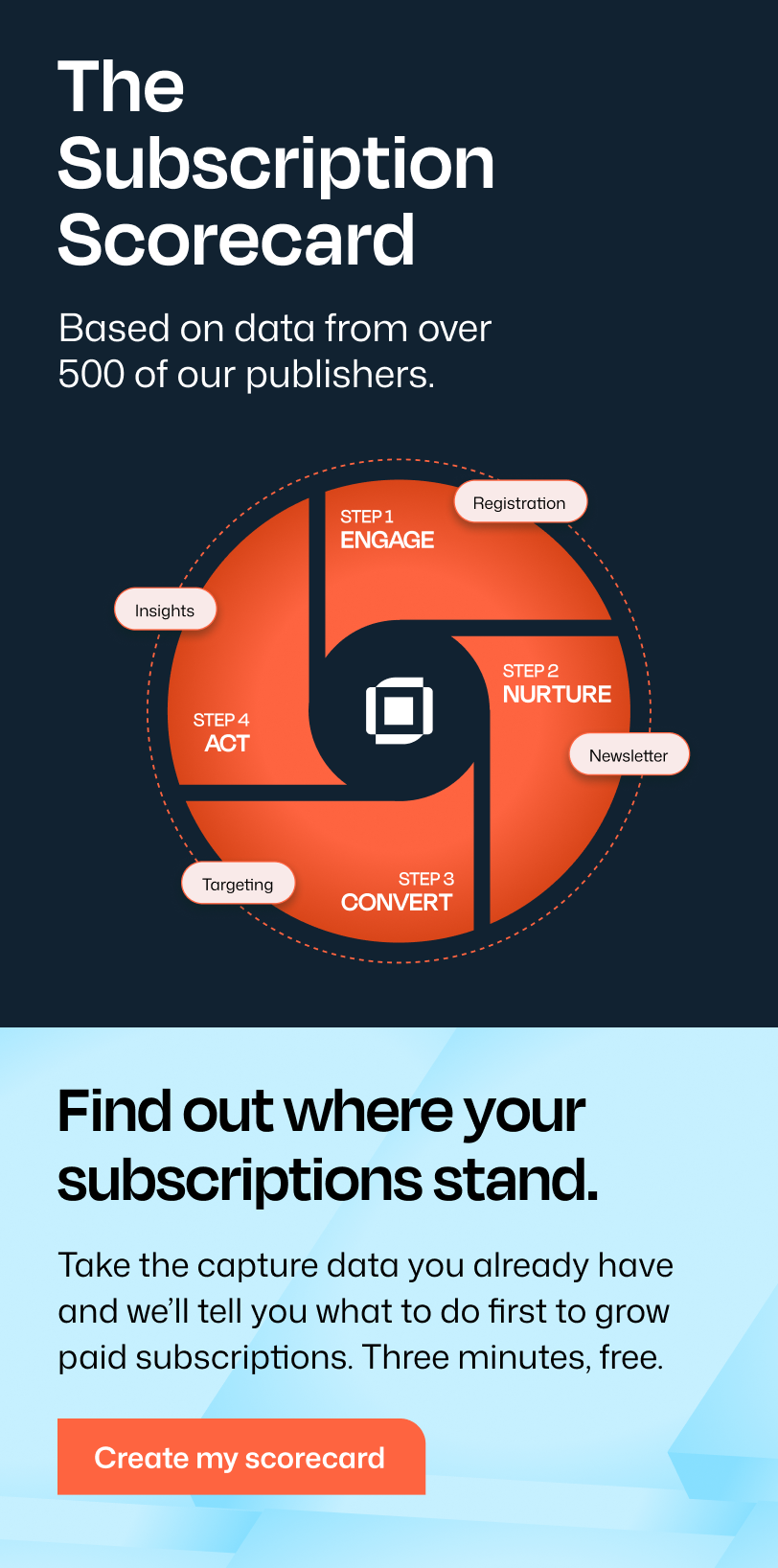
That’s the Publisher Flywheel in motion. You capture the email at the wall, keep readers engaged with the newsletter, and send that traffic back to the site to convert over time. The bigger your list of engaged readers gets, the more the whole thing feeds itself.
Promo alert: a free registration wall is the single highest-leverage thing most publishers can turn on today, and it’s exactly what Leaky Paywall is built to run. List Builder puts a clean registration wall on your own WordPress database, Flowletter handles the newsletter workflow, and AI Subscriber Insights show you what’s converting. See how it works.
You don’t need to lock a single article to start getting paid. You need readers to identify themselves first, and enough membership value to make paying worth it once they have.
I help publishers turn casual readers into loyal subscribers through smart, flexible paywall strategies. When I’m not deep in subscription data or newsletter growth, I’m usually caffeinated and acting as a full-time mediator between a dog and a cat who refuse to see eye-to-eye.
Learn how Leaky Paywall can help grow your subscription revenue