The average visitor to your site reads 1.7 articles per session. Not per month. Per visit.
That single number should change how you think about your paywall.
Most publishers set their meter at 3, 4, or 5 free articles before gating content. It feels generous. It feels safe.

But if your typical visitor never gets past article two, a meter set at 3 or more means most of your traffic never sees your wall at all. Your “generous” paywall is invisible.
The math behind 100,000 visitors
Run the numbers on a site with 100,000 monthly visitors.
At a 1-article meter (one free article, wall on article 2), roughly 70,000+ of those visitors see your registration wall.
At a 3-article meter, that number drops to around 30,000.
At a 5-article meter, almost none do.
Same traffic. Same content. A wall that’s either doing its job on two-thirds of your visitors, or sitting dark for two-thirds of them, depending on one setting.
Tightening the meter doesn’t cost you customers. It filters out anonymous traffic that was never going to convert (we’ve watched publishers make this switch and worry for nothing).
Looking to grow your publication?
Sign up for expert advice straight to your inbox.Why a loose meter feels safer, and isn’t
The instinct to give readers “enough” free content before asking anything of them makes sense on paper. In practice, the data runs the other way on both ends.
Across a set of 9 publishers running the same tool with a 1-article meter (wall on article 2), registration wall conversion rates ran 3.2% to 6.7%. A European regional newsroom landed at the low end. A financial publisher hit 3.9%, a niche hobby site hit 6.4%, and a local news site topped the range at 6.7%.
Loosen the meter and conversion collapses. A 6-article meter drops conversion to roughly 1.4%. Remove the meter entirely (0 free articles, wall on everything) and it’s worse: 0.1%.
Both extremes fail. The wall only works when readers actually run into it, but not so hard that it feels punitive before they’ve gotten anything.
One free article. A wall on the second. That’s the number that keeps showing up in the data.
The one-and-one framework
Here’s the whole strategy in six words: one free article, register for more.
If you’re building toward paid subscriptions, extend it by one more step: one free article, register for one more, upgrade to paid.
That’s the one-and-one framework. Here’s the funnel behind it:
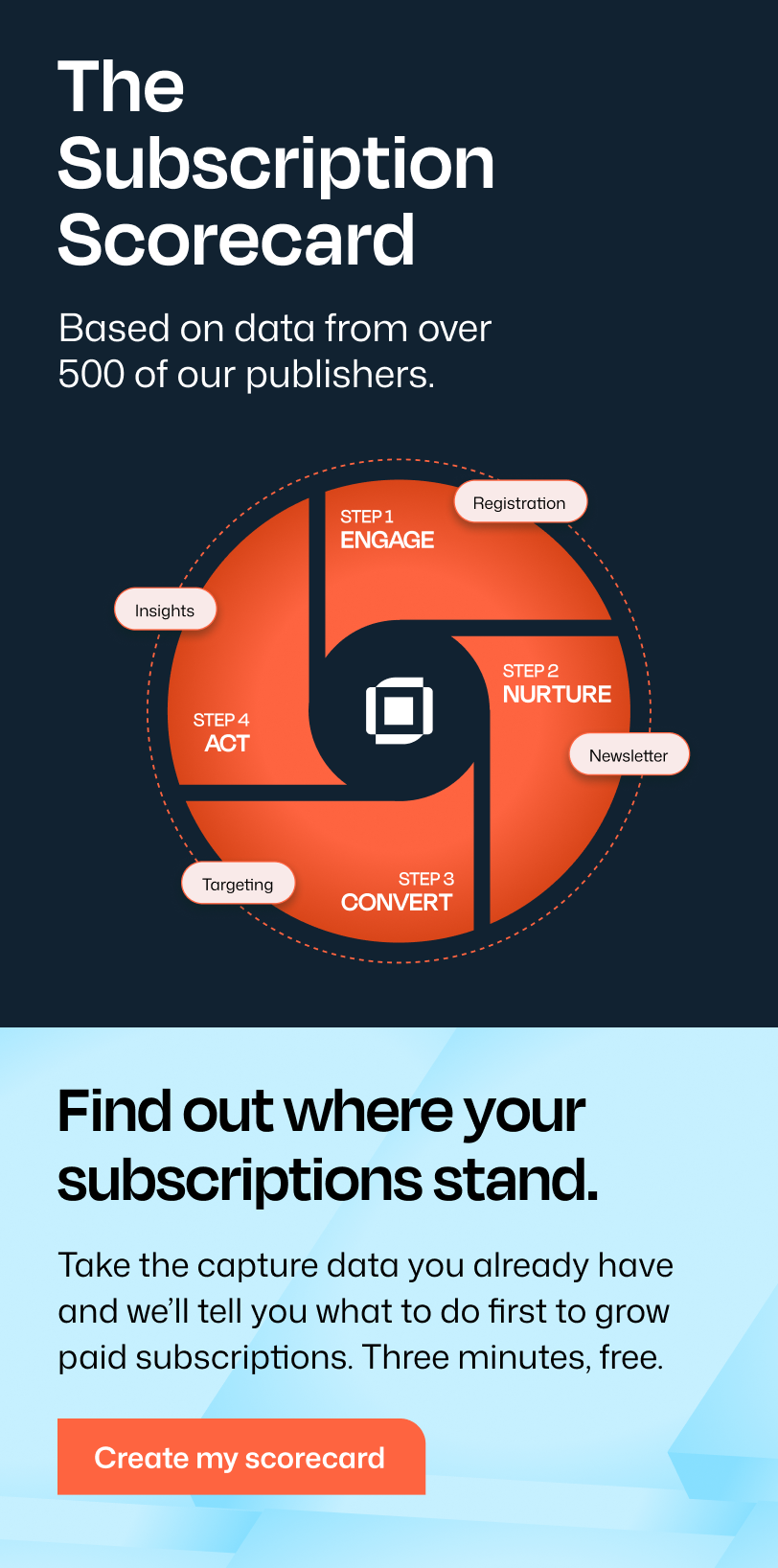
Free content builds trust. A registration wall, not a paywall, captures an email address (List Builder is built for exactly this step). A newsletter nurtures that reader.

A paywall, shown to a warmed, registered audience, converts 3-5x better than a cold wall shown to a stranger. From there, an annual plan captures the real revenue, with monthly kept in your back pocket for engaged free readers who aren’t ready to commit for a year.
Every step depends on the one before it. Skip the registration wall and go straight to a paywall, and you’re asking a stranger who has read a page and a half to trust you with a credit card. Almost none of them will.
What this looks like with real publishers
Salem Reporter runs a registration wall in Oregon. In a clean 30-day head-to-head test, that wall captured 16x more email signups than their newsletter signup forms.

The bigger number: over 20% of readers who registered through the wall converted to paid, compared to under 1% for a cold paywall with no registration step first. The audience didn’t change. The sequence did.
Mexico News Daily runs a stricter version: registration wall on article 2, paywall on article 3. In about a year and a half, they grew from under 500,000 monthly visitors to 1.4 million, on zero ad revenue. Their email list tripled over the same stretch.

Neither publisher got there with a generous meter. They got there with a tight one, and a real sequence behind it.
“Won’t a tighter meter tank my traffic?”
This is the objection every publisher raises before tightening a meter, and it’s worth answering directly, because it’s the one thing standing between most sites and 70,000 wall impressions instead of 30,000.
A tighter meter doesn’t cost you traffic. A registration wall on article 2 still lets readers in on article 1, and still lets search traffic reach your homepage and your archive. What changes is whether the reader who was never going to subscribe anyway registers an email on their way out, instead of leaving with nothing.
One head-to-head test makes the tradeoff clear: two sites, one platform, one niche, one price point. The site running a 1-article meter with weekly newsletter sends pulled in 62,754 registrations.
The site running a 2-article meter with twice-daily sends pulled in 27,510 fewer registrations but 4x more paid conversions. Traffic held steady at both sites. What changed was how much of it converted into something the site actually owned.
The metering confidence ramp
Some publishers aren’t ready to jump straight to one free article, and that’s fine. The meter is a dial, not a switch. There’s a documented path from where you are now to one-and-one, and it doesn’t require a single leap.
- Level 1, cautious: 4-5 free articles. The wall barely fires, but you’re live and watching real data instead of guessing.
- Level 2, tighten: 3 free articles. This step exists to prove nothing catastrophic happens, not to convert readers.
- Level 3, traction: 2 free articles. Conversion lands around 0.9%, about the same as a cold popup (0.9-1.45%). It works as a waypoint. It’s a weak place to stop.
- Level 4, optimal: 1 free article, wall on article 2. This is the 3.2%-6.7% band from earlier, and it’s the destination, not one option among four.
Watch two numbers as you move through the levels: registrations per day, which should climb, and traffic, which should hold steady. If both check out, tighten again.
Set your meter at one
If you’re running a 3-, 4-, or 5-article meter today, treat it as a starting line. Most of the people who land on your site will never see a wall that sits past article 2.
One free article. Wall on the second. That’s the whole one-and-one framework, and it’s the only setting the data actually supports.
Check your meter setting today. If you’re mid-ramp, keep tightening. If you’ve been parked at the same level for months, it’s time to tighten again.