Different publishers keep seeing wildly different subscription numbers, and the data is messy—comparing online news publications is rarely apples‑to‑apples. That leaves most teams guessing which tweak to try next.

So what if we could watch two nearly identical news sites—same niche, same WordPress + Leaky Paywall stack—run side by side and reveal a clear blueprint for faster email growth, traffic, and convert more paid subs 20% faster?
We did it for you.
Running two nearly identical news sites on the same WordPress + Leaky Paywall stack should, on paper, produce near‑identical outcomes.
It doesn’t.
Small choices—when to email, how many freebies to give, where a button sits—compound into a 4× gap in paid conversions. This case study is your lab report: Two publishers show what happens when different approaches meet real audiences, and what lessons any newsroom can learn.
Disclaimer
To protect commercial data and editorial strategy, the newsrooms profiled here are referred to simply as “Publisher A” and “Publisher B.” All metrics are shared in aggregate form with permission, and no proprietary details or brand identifiers have been disclosed.
Why Compare These Two Publishers?
Publisher A and Publisher B target the same audience niches, rely on identical stacks (WordPress + Leaky Paywall + Flowletter), and charge almost identical subscription prices.
In other words, they represent any newsroom that’s already invested in the “standard” reader‑revenue toolkit. Yet their outcomes diverge in two fascinating ways:
- Publisher A is the conversion champ, turning a much larger slice of those free readers into paying members.
- Publisher B is an email‑collecting machine, pulling in the biggest batch of new sign‑ups month after month.
This case study matters because it shows that success isn’t locked inside the tech—it’s in the strategy: cadence, deliverability, CTA placement, and how generous (or stingy) you make that first taste of content.
Looking to grow your publication?
Sign up for expert advice straight to your inbox.If your own numbers feel stuck, the contrast between A and B offers a playbook of quick wins and cautionary tales you can apply without swapping tools or rebuilding your site.
30-Day Stat Sheet

Insights for Publisher A (Conversion Champ)
Newsletter-Driven Page Views
The real engine behind A’s growing traffic isn’t search—it’s the twice-daily newsletter. Each send drops fresh headlines straight into inboxes and sparks predictable surges of return visits morning and night. Those email “pulses” keep pages-per-session healthy and routinely top up overall page-view counts, proving that a reliable cadence can outperform even the best SEO.

Upgrade messaging in newsletter
Every newsletter carries a bright, above‑the‑logo “Upgrade” button. It shows up in mobile previews and reminds free readers—twice a day—that full access is only a click away.
Registration Wall Approach
Publisher A lets readers sample two free articles before asking for an email. That extra read lowers friction, builds goodwill, and keeps bounce-outs minimal.
Conversion Muscle
Thanks to the friendlier two-article meter and a solid nurture sequence, Publisher A turns about double the percentage of its new sign-ups into paying subscribers compared to B.
What Publisher A Could Borrow from Publisher B
Borrow B’s punchy, first-article registration gate to scoop even more email addresses, then run them through A’s already-proven newsletter strategy.
Insights for Publisher B (List Builder)
Keeping Readers Around
Thanks to a mid-article “Read more in this category” link, visitors average ≈ 2.2 pages per session—higher than A’s 1.7. Related articles are also promoted after the main content. More clicks mean extra chances to show the upgrade offer.
A Sharper “FREE” Ask
The gate pops up after the very first article with a bold “This story is FREE for you…” line, one email field, and a premium-upgrade link—all on a single card. It captures the most new addresses each month.
Pressure Meter
B allows just one free read before locking content, so readers feel immediate urgency to hand over an email.
Ad Clutter
Heavy ad placements crowd the layout and can undercut trust. That noise is a likely culprit behind B’s lower free-to-paid conversion rate—people sign up, but eventually bail when the experience feels too spammy.
What Publisher B Could Borrow from Publisher A
Lighten the ad load, add A’s twice-daily newsletter cadence, and soften the meter to two articles. The combo could warm up those extra sign-ups and lift conversions without sacrificing list growth.
Early Engagement: Growing and Nurturing the Email List
Securing an email address is only the first half of the job; nurturing that new contact and nudging them toward “Subscribe” is the other half. Here’s how the two publishers diverge.
Publisher A’s ask: Pops up after the second article. The banner is wordy and hides the upgrade link at the very bottom. This makes it easy for readers to bail.

Publisher B’s ask: Appears right after the first article with a bold “This story is FREE for you…”. An email and password field, a tight benefit, and a clear premium‑upgrade link sit in a single card. Faster, clearer, and why B has collected about 62,754 free registrations so far versus A’s 27,510.

The numbers back it up: A has gathered roughly 27,510 total sign‑ups and still converts significantly more to paid, but B’s larger list proves how a clear, FREE‑forward prompt removes friction right at the starting line.
Stuffing the email list is easy; nurturing it to subscription is the real game.
Prime Spots for Upgrade Button
Headlines pull readers in, but CTAs pull out the credit card. Nail the placement or lose the sale.
In‑article nudges
- Publisher B nails the scroll‑stopper. Publisher B sneaks a “Read more from this category” link halfway down and at the end of every story. That tiny nudge keeps people hopping to the next piece and it shows in the numbers: B averages 2.1 articles per visit, while A tops out at 1.7.

Email asks
- Publisher A owns the preview pane. Its “Join our Subscriber Community” button sits above the logo, so the pitch is visible even in a mobile preview..
You don’t need more buttons; you need one unmissable button right where eyes land first—mid‑scroll in articles and top‑of‑email in the inbox.
Newsletter Strategy

Your newsletter cadence is the pulse of your brand. Hit the inbox regularly, and readers will instinctively watch for your next send.
Publisher A hits the inbox twice a day—an AM briefing and a PM recap. Every welcome email lands, and the upgrade button sits right in the header.
Publisher B sends one daily digest to subscribers and five emails a week to the free list. About a quarter of its welcome emails go missing, and open rates lag far behind A.
Quick fixes:
- Copy A’s AM + PM cadence. Add an evening roundup—even just three headlines and one takeaway. Two predictable touch‑points lock your brand into the inbox routine.
- Stick the upgrade button up top. Place the upgrade button above the logo, give it a pop‑color, and keep the copy to three punchy words so it shows in mobile previews.
The Big Takeaway — Steal What Works, Ditch What Drags
This case study spotlights each publisher’s strengths. Grab the tactics that fit and slot them into your own stack:
- Ask early, ask “FREE.” Drop the registration prompt after the first article and headline it with the word readers love most.
- Keep the copy tight. One sentence of benefits, one email field, one bright button—done.
- Send twice a day (but keep it bite-sized). Habit beats hype. Morning brief + evening recap keeps you top-of-mind without clogging the inbox.
- Surface mid-story and end of article related article links. A single “Read more in this category” halfway down the page can boost pages-per-visit by 20 % or more—extra chances to pitch premium.
These two publishers prove the inbox is where the real game is played.
Publisher B shows that a punchy, “FREE”-forward registration wall can flood your list with new readers, but Publisher A reminds us that habits, deliverability, and a fair sample are what turn those readers into paying fans.
List volume is nice, but list value pays the bills. Lead with B’s punchy “FREE” invite, keep A’s steady email rhythm, and watch your conversions grow.
HOW THE FLYWHEEL FRAMEWORK TIES IT ALL TOGETHER

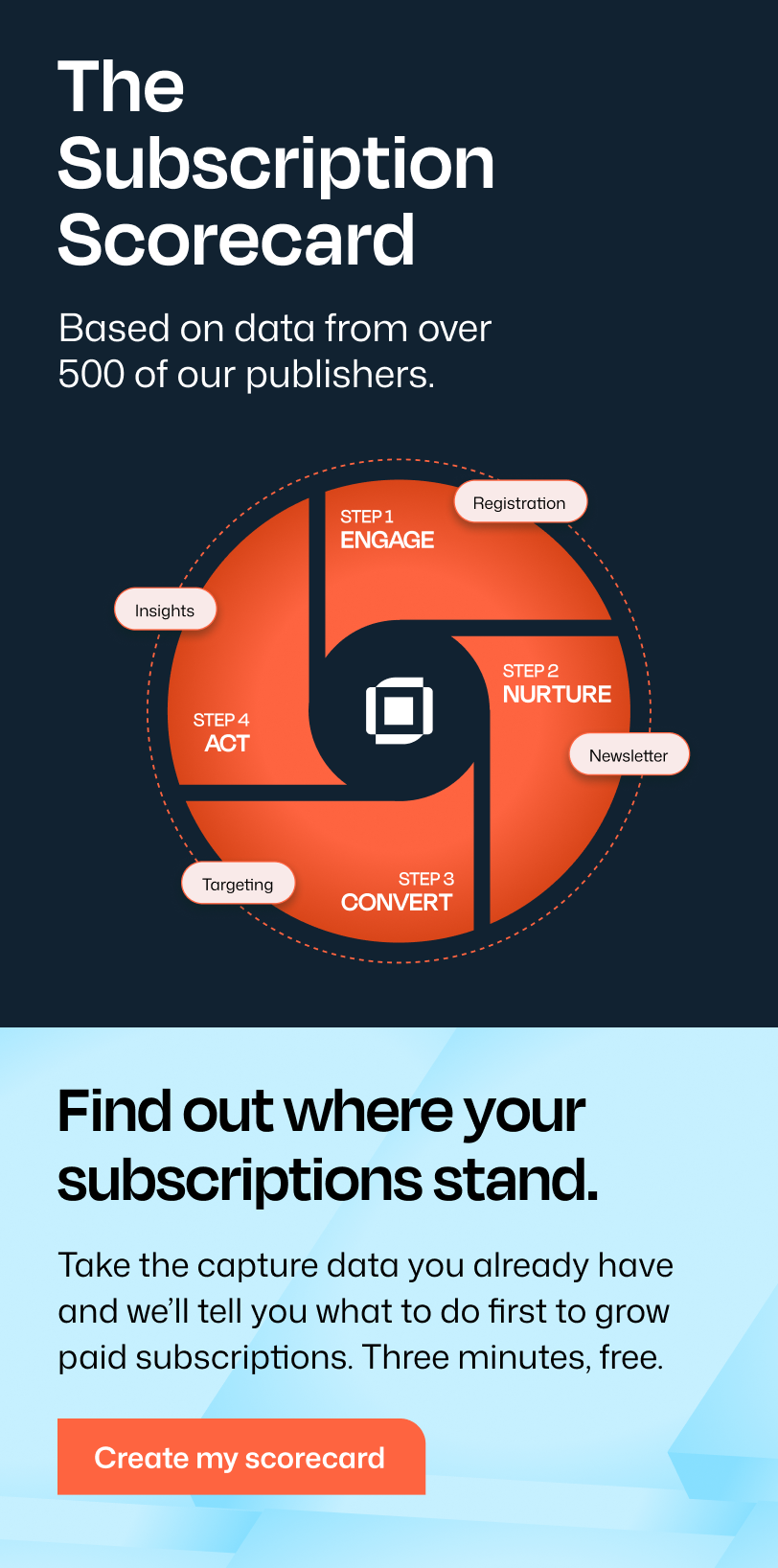
Both publishers reveal different parts of the same puzzle, and each step lines up with Leaky Paywall’s Flywheel Framework: Capture readers with a quick “FREE” wall, Nurture them with steady emails, Convert the engaged ones with clear upgrade buttons, then Repeat by nudging sleepers back into the loop.
That Flywheel—capture, nurture, convert, repeat—is why one site’s list keeps growing and the other’s subs keep paying. Spin all four steps together and the revenue snowballs.
Want the step‑by‑step playbook? Check our full Flywheel Framework guide for the details.
Curious what the Flywheel Framework can do for you? Shoot us a message or hop on a call with Pete to learn more.
Let’s talk paid subscriptions

Want to learn more about growing your audience and converting subscribers with your paywall? Get in touch with Pete.