Warren Buffett just put $351 million into the New York Times. Six years ago, he sold his entire newspaper portfolio for $140 million. That gap is not a contradiction; it’s a signal. The New York Times spent 15 years building a metered paywall strategy that turned a struggling, ad-dependent publication into a subscription machine generating $1.4 billion in reader revenue per year. On this episode of the Paywall Podcast, we unpack exactly what they did, when they did it, and how you can copy it at your scale.
In this episode, Pete and Tyler walk through the New York Times’ 15-year metered paywall evolution, from a bold and widely mocked experiment in 2011 to a blueprint that Warren Buffett just validated with a nine-figure investment. Whether you run a local news site, a niche magazine, or a B2B publication, the sequence the Times used maps directly to what publishers can do today with the right tools.
The Problem: Ad Revenue Was a Trap
Back in 2003, the New York Times ran almost entirely on advertising. Print was dominant, digital advertising was growing, and the model felt sustainable. Then 2008 hit. Ad revenue collapsed, and the Times found itself borrowing money to survive. By 2009, the numbers were in freefall.

This is not an unfamiliar story. Advertising revenue is a platform you do not control. When it drops, it drops fast — and publishers who built everything on it had no fallback. The Times had to make a choice: keep relying on a broken model, or build a direct relationship with readers.
The Promise: A Replicable Sequence, Not a Scale Play
The common objection to the NYT as a model is that they are the New York Times. The assumption is that their paywall works because of their brand, their budget, or their volume of content. Tyler pushes back on this directly in the episode.
The model works at all stages. Small-town regional, national, niche — the scale changes, but the sequence does not. What the Times built was a conversion funnel that moves readers from anonymous visitors to registered users to paying subscribers. That funnel is available to any publisher willing to follow the same steps.

The Metered Paywall Strategy: Tighten, Measure, Repeat
Here is the actual timeline the Times followed, and what it means for your publication.
Start generous, then tighten over time.
In 2011, the Times launched with 20 free articles per month. In 2012, they dropped it to 10. In 2017 — the so-called “Trump bump” — they cut it to five. Today, new visitors get zero free articles without registering. That 15-year arc is not hesitation. It is confidence-building. They tested, watched the numbers, and tightened when the data supported it.
Looking to grow your publication?
Sign up for expert advice straight to your inbox.If you are currently running three, four, or five free articles before showing a registration or subscription prompt, you have room to tighten. The average visitor reads 1.7 articles per session. That means most of your traffic will never see your paywall if your meter is set above two. Start where you are comfortable, then watch what happens to your email list and subscriber numbers. Tighten by one. Watch again. Keep going.
Add a registration wall before you ask for money.
In 2019, the Times introduced a free registration wall. This is the move most publishers are still not making. Instead of asking anonymous visitors to pay immediately, the Times asked them to create a free account first. That single step, creating an email-gated login, did more to build their subscriber pipeline than almost anything else.
The math behind it is straightforward. Registered users convert to paid subscribers at ten times the rate of anonymous visitors, according to Piano’s research. Salem Reporter, a local news site in Oregon, saw their registration wall generate 16 times more email signups than a standard newsletter form — and one in five of those registered readers became paying subscribers.
If you are not running a free registration wall today, you are sending the majority of your most engaged readers into the void with no way to follow up. Leaky Paywall’s List Builder makes this straightforward to set up on WordPress without any custom development.
Create upsell tiers once your base is paying.
The Times did not stop at a single subscription tier. They built games, recipes, audio, and Wirecutter — each one a reason for a different type of reader to upgrade. Pete describes how his own household started with a basic subscription, added recipes, then ended up on the all-access family plan. They never paid more than they were ready to pay. The Times just kept creating the next logical step.
You don’t need the Times’ product budget to apply this. A few examples from Leaky Paywall publishers that are working right now:
- Ad-free plans: A Swedish publisher called Samnytt runs a 99 Kronor ad-free tier alongside their standard subscription. Over 10% of their revenue comes from that single upsell.

- Print bundle add-ons: California Fly Fisher adds a physical issue at checkout with a simple checkbox. Small Boats Monthly has done the same with a holiday edition.
- Classified access: Small Boats Monthly lets paid subscribers post unlimited classifieds, turning the subscription into a two-way marketplace for their niche audience.

The Payoff: Getting Off the Platform Treadmill
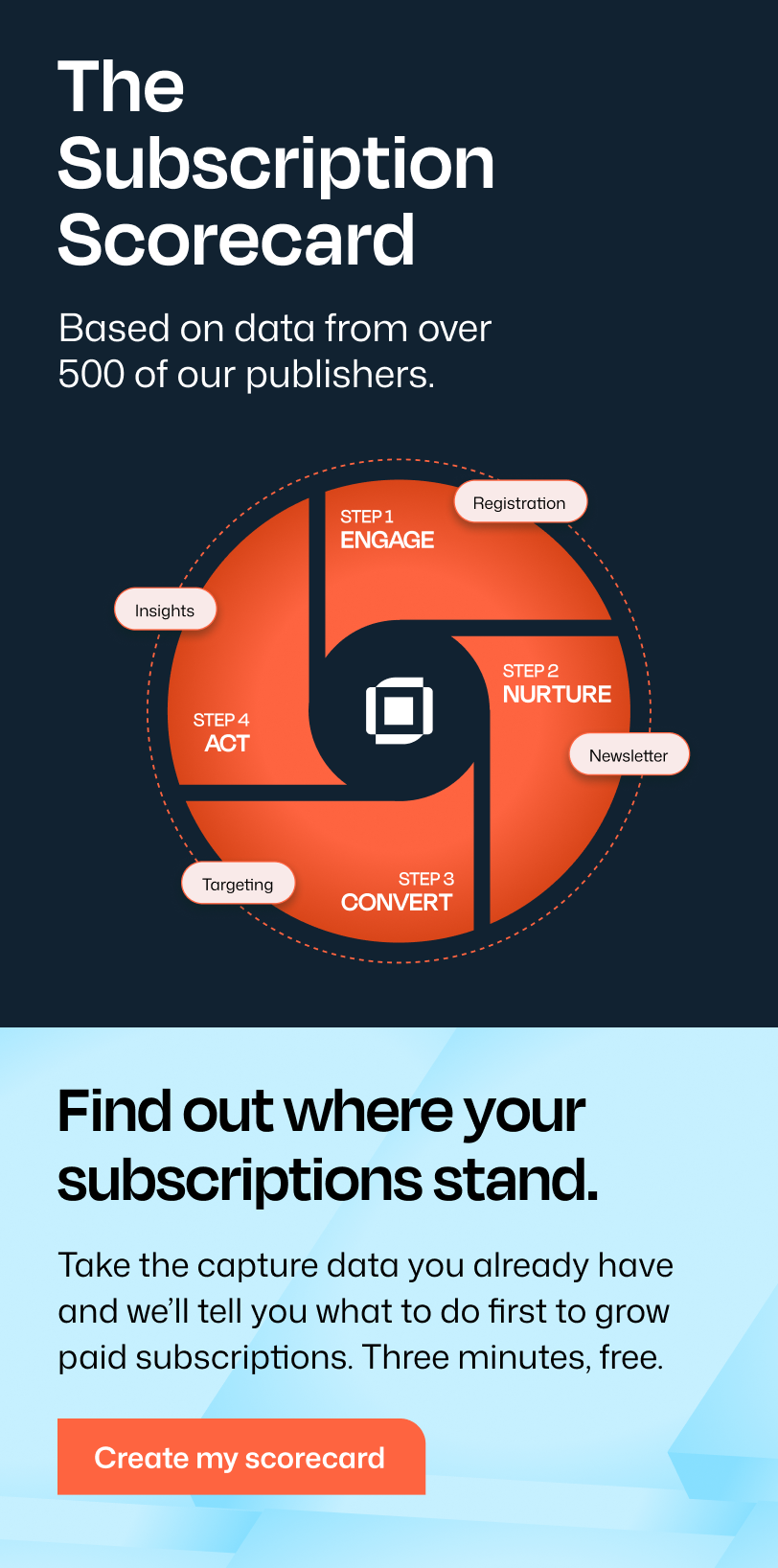
When the flywheel is working, readers register, get your newsletter, come back to the site, and eventually convert. Something shifts. Your email list becomes your primary traffic engine. You are no longer dependent on Google’s algorithm changes or social media platforms you have no control over.
That is what the New York Times has built. Reader revenue is now 69% of their total revenue. They have 12.8 million digital subscribers with a stated goal of 15 million by 2027. And now Warren Buffett, who famously sold his newspapers for $140 million in 2020, just bought $351 million worth of the Times.
The sequence is not complicated. A metered paywall to let readers sample. A registration wall to capture the engaged ones. A newsletter to bring them back. Upsell tiers when they are ready. Tighten the meter as your confidence grows. The Times took 15 years. You don’t have to.
Watch the full conversation: