The Short Version
Google search traffic to US publishers is down 30-38%, and AI Overviews now answer the reader’s question without the click. For every 100 clicks a top page used to earn, Google keeps 58.
A smart paywall does two jobs at once: it keeps AI scrapers out and turns the human readers who get through into a list you own. A registration wall captures 3.2-6.7% of readers who see it versus 0.9% for a popup, and registered readers convert to paid at up to 45x the rate of anonymous traffic.
This guide shows you how to protect your content inside WordPress with Leaky Paywall, with real publisher numbers behind every move.
You publish a big investigation at 6 AM. By 6:07, an AI chatbot is quoting your paragraphs word for word. Readers share the chatbot’s summary instead of your story. Advertisers don’t see the traffic. Your biggest piece of the year is out in the open, and you got nothing for it.

AI scrapers crawl faster than humans can refresh a page, siphoning premium work to feed models that never credit or compensate publishers. If you rely on reader revenue, every stolen article chips away at subscriptions and ad value.
Here’s the part most guides miss. Blocking bots is only half the fix. The other half is capturing the human readers you still get, before AI takes them too. A smart, AI-ready paywall does both: it keeps bots out and invites real people in. The solution lives inside WordPress with Leaky Paywall, running a flywheel that turns every visit into list growth and paid conversions.
The rising threat of AI paywall circumvention
The threat isn’t coming. It’s already priced into your traffic reports.
Google search traffic to US publishers is down 30-38%. When a reader sees an AI Overview, click-through rates drop 58% versus a traditional result. Ahrefs found that for every 100 clicks a top-ranking page used to earn, Google now keeps 58. The user gets the answer. You produced the answer. You don’t get the visit.
AI crawlers move fast. Before you finish your coffee they can copy every headline and paragraph on your site. Many pretend to be Google or slip through cached pages, so your server logs look fine while your archive lands in a training set.
Looking to grow your publication?
Sign up for expert advice straight to your inbox.
Bots do more than grab full articles. They stitch pieces together. A social teaser, a newsletter snippet, an RSS chunk, all of it can be reassembled into a readable story that slides past your paywall and shows up in search. Each fragment they lift erodes the value readers pay for.
Niche publishers used to think they were safe. That’s gone. A regional fishing publication watched Google’s AI Overviews pull answers directly from their fishing reports, reviews, and seasonal alerts. If content that specialized is getting scraped, your content is getting scraped too.
Traditional paywalls were built for people, not robots. Clear cookies and you get fresh views. Switch IP addresses and the counter restarts. AI scrapers automate these tricks around the clock, turning your hard-earned journalism into free chatbot fuel and costing you both readers and revenue.
Publishers are fighting back in court. A group of lawsuits against OpenAI and other firms was combined in New York. Legal wins will take years. You need protection right now.
How smart paywalls protect valuable content
A paywall is a front door for your site. The trick is picking the right lock for where you are in your publisher journey. Think of it as three levers.
1. Hard paywall (zero free views). Everything is locked top to bottom, so AI crawlers hit a blank wall. This fits established brands with loyal fans that don’t lean on Google traffic. The New York Times went from 20 free articles a month to zero over a decade, and their subscription curve accelerated as the meter tightened.
2. Free-registration wall. Readers hand over an email before they read more. Most bots can’t fill out forms, so they bounce off. You keep the content for real people and grow your list at the same time. This is the highest-leverage setting for most publishers, and the data below shows why.
3. Metered access (one or more free articles). Let readers view a set number of free articles, then show the registration wall. Google and AI can still crawl and index those free pages, which helps newer publishers get discovered.
Here’s the number that decides where to set your meter. According to Google, the average visitor views 1.7 articles per session. Not per month. Per visit. Check your own analytics and you’ll find something close.
That single stat rewrites the rulebook. A 3-to-5 article meter means almost nobody ever reaches the wall. Run it against 100,000 monthly visitors: a 1-article meter shows your wall to roughly 70,000 people, a 3-article meter to about 30,000, and a 5-article meter to almost none. Publishers think they’re being generous. They’re effectively invisible, to readers and to their own list.
The registration wall is the strongest lock for the money. Measured across 12 publishers running the same tool, a registration wall after one free article converts 3.2-6.7% of readers who see it. A newsletter popup, measured the same way across five Newspack publishers, converts 0.9%. That’s a 2-7x improvement. Popups ask. Registration walls require.
Salem Reporter, a news publisher in Oregon, ran a 30-day head-to-head: registration wall against their old in-content newsletter form, same audience, same week. The wall won 16 to 1. Today over 20% of those registered readers convert to paid.
A paywall that fits your journey
Leaky Paywall lets you flip between these levers in minutes. A new publisher might start on a one-article meter to pull in search visitors and collect emails. When that list drives steady sales, switching to a harder wall is a few clicks away.
You can also lock a premium section while leaving lower-value posts metered. That keeps evergreen hits on Google but hides the pieces readers will pay for.
Leaky Paywall adds guards behind the curtain, too. The Incognito Blocker catches readers who reset cookies for extra free reads. Category rules seal off whole sections with one setting. Together, these build an AI-smart paywall that protects your work without slowing growth.
AI detection vs traditional paywall methods
Old paywalls lean on cookies and bits of JavaScript. Smart bots skip the fancy code and grab the raw HTML, walking right through the front door.
Blocking every crawler sounds great until you remember Google’s AI Overviews sit at the top of search. Slam the door on all bots and your stories vanish from that prime real estate. The move is to block the freeloaders, charge the maybes, and still welcome the crawlers that send you traffic.
Start with robots.txt. This tiny text file is your house-rules sign. List the AI user-agents you don’t trust and tell them to stay out. Most big bots respect it, so one line of code knocks out a chunk of unwanted scraping. Not guaranteed, but a solid first layer.

Test-drive pay-per-crawl. Cloudflare rolled out a beta that lets you let an unknown crawler in for free, block it, or make it pay before each request. Newer tools serve a 402 “payment required” response to AI agents specifically. It’s a fresh way to flip scraping into a revenue stream. Be realistic on the payout, though: a site with a million monthly pageviews might pull in $20 to $200 from bot tolls. I broke the numbers down here. For a national outlet that starts to matter. For a local or niche publisher, it’s pennies, which is exactly why owning the reader relationship beats taxing the bot.
Leave the door open for Google’s AI Overviews. Google says you don’t need special tags to show up in its summaries. You just have to let Googlebot crawl. Keep those paths clear, follow basic SEO, and your articles can still land in the box that drives new readers.
Leaky Paywall hooks into each layer. A bot sneaks past robots.txt? Your paywall still holds. Reader keeps resetting cookies for free reads? The Incognito Blocker stops them. Stack these together and you get true defense in depth.
Turn readers into subscribers with targeted messaging
Bots are only half the battle. The real game is nudging human readers to subscribe, and the reader you convert has already opted in. Registered, newsletter-subscribed readers convert to paid at up to 45x the rate of anonymous traffic. A Piano benchmark found cold paywalls converting at 0.22% of visitors versus 9.88% for registered users.
Leaky Paywall’s Targeted Messaging add-on makes that simple, no fancy AI required.
Speak to each reader by status. First-time visitor gets a “This story is free” banner. A free-reg reader who gave you an email but hasn’t paid sees “Unlock full access, three months for the price of one.” A paid member gets a quick “Thanks for supporting us.”

Match messages to content. Sports tag on the article? Push a “Go ad-free sports pass” offer. Business section? Try “Upgrade for deep-dive reports.” You control which tags fire which message.
Then let the newsletter close the deal. Flowletter, built into Leaky Paywall, drops each new address into the right list. Free-reg folks get a steady drip of “here’s what you’re missing” teasers. Paid subscribers get member-only alerts plus a one-click link that skips the login screen.
How A Paywall Can Pump Up Emails, Traffic, Subs, and Ad Revenue
Editors worry a wall will make ad views fall off a cliff. The data says the opposite. Here’s the Publisher Flywheel:
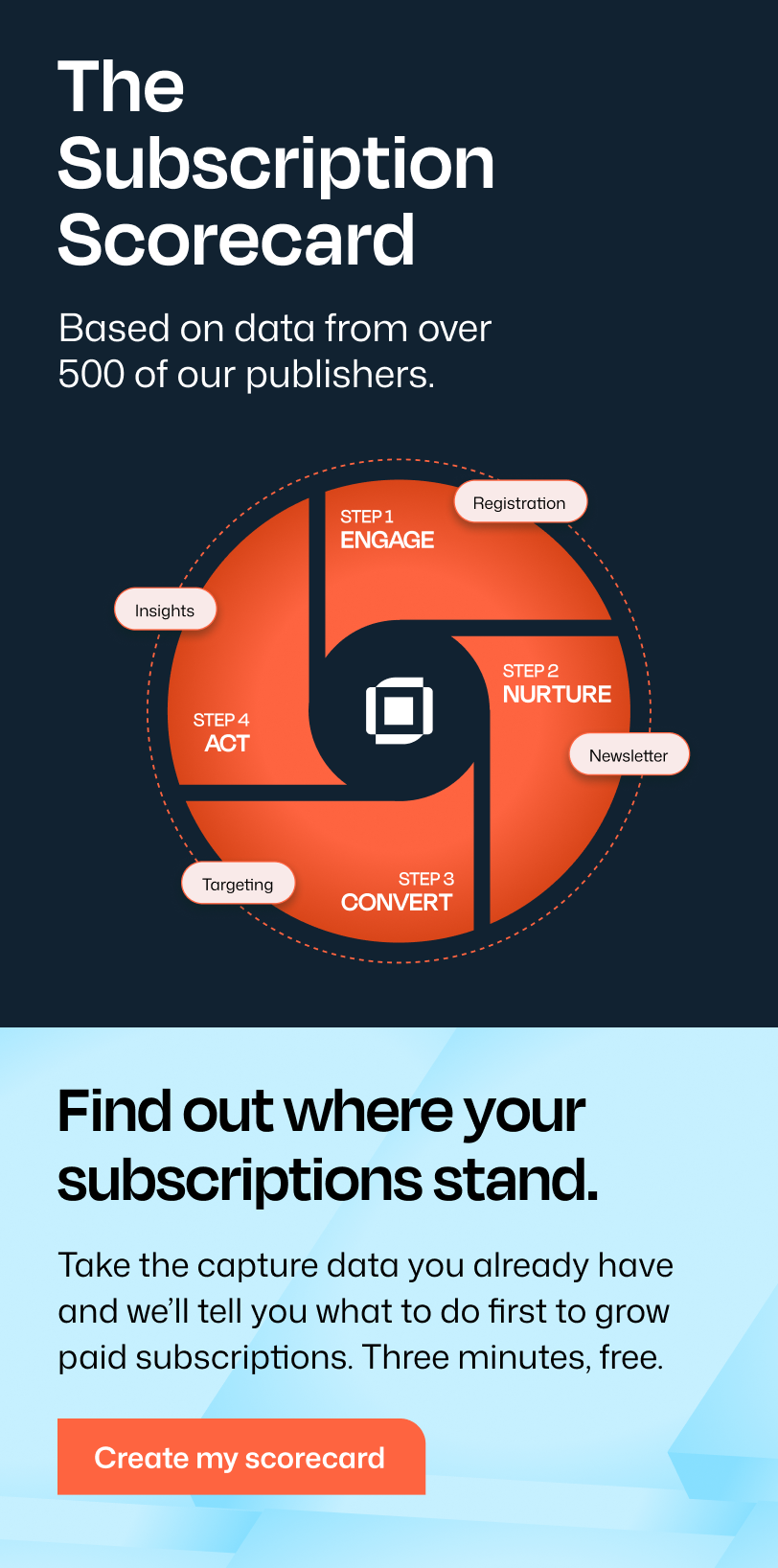
Content > Registration wall > Email list > Newsletter > Return traffic > Conversion > Subscriber insights > Actionable improvements

Every piece connects, and no piece works alone. Walk it through.
The wall grows your list. A free-registration wall grabs emails from casual readers instead of letting them leave anonymous. Bigger list, more people to invite back.
Emails bring readers back. You send a newsletter, they click, they read, they stick around. Frequency compounds it: in a head-to-head of two publishers on the same platform, same niche, same pricing, the one sending twice daily converted paid subscribers at 4x the rate of the once-daily sender. The newsletter is the engine, not a byproduct.
More time on site lifts ad rates. And first-party data lifts them more. Ezoic data shows publishers who identify their users see CPM lifts of 25-40%, roughly double the ad fill rate, and about 2x revenue per thousand visitors for matched-identity readers. Digiday Research found 85% of publishers expect first-party data to be their biggest ad revenue driver. A registered reader is worth roughly twice as much because the advertiser knows who they’re reaching.
Then the extras stack on top. Ad Dropper keeps banners for free readers and gives paid members a clean page, so you keep impressions rolling. A growing free list makes advertisers happy while a paid list charges a premium for member-only content. And you can run sponsor shout-outs just for the paid readers who trust you most.
The old myth that paywalls kill ads keeps hanging around. The numbers say different. Use the right wall, spin the flywheel, and you grow subscription revenue and ad revenue at the same time.
Two publishers prove it at opposite ends of the size scale. Greenpointers, a donation-funded Brooklyn neighborhood site, turned on a registration wall at a generous three free articles. In six weeks it added over 1,500 new emails, the list grew 17%, and traffic climbed 40% month over month, with no new content. Mexico News Daily grew from under 500,000 monthly visitors to 1.4 million over roughly two years, running a registration wall on article two, a paywall on article three, and two newsletters a day. They ran zero ads.
Implementing effective AI paywall solutions for WordPress
Want to block bots and grow paid readers? Four steps.
1. Sort your content first. Tag each section: premium stories to lock fully, SEO pieces you want Google to see, community posts you’ll trade for an email. One rule of thumb from the data: everything original you publish is premium to the reader who clicked it. They self-selected. Gate more than you think you should.
2. Install Leaky Paywall and its add-ons. It installs like any WordPress plugin, and all your subscriber data stays on your site.
3. Pick the wall that fits each section. Free-reg wall asks for an email after a teaser. Metered wall gives a set number of free reads before the ask. Hard wall shows nothing until they pay. Mix and match: lock “Investigations” with a hard wall, meter “Lifestyle,” keep “Events” open with a free-reg prompt.
4. Watch two numbers and adjust. Registrations per day: is it going up? Total traffic: is it holding or growing? If registrations rise and traffic holds, the setting is working. If registrations are flat, your meter is too generous. Start generous, then tighten. The Fisherman switched from an in-content form to a full-width, email-only overlay and saw free registrations jump 10x in two weeks.
Spend one afternoon on these steps and you’ll have an AI-smart paywall that blocks freeloaders, grows your list, and turns loyal readers into paying supporters, all inside WordPress.
So, how do you protect content from AI and still grow?
It depends on where you are in your paywall journey.
If you’re just starting, stay a little open. Give one free read, then ask for an email. That keeps you in search, gets you seen in AI Overviews, and grows a list you control. The list powers the flywheel: capture, nurture, convert.
As you grow, tighten where it matters. Lock a premium section and keep other posts metered. Use Targeted Messaging to show the right offer to the right reader, and Flowletter to send the right email at the right time. Keep ads for free readers and remove them for members with Ad Dropper.
When you’re established, go stronger. Put your best work behind a hard wall. Add simple shields like robots.txt and your CDN’s bot controls. Turn on the Incognito Blocker to stop meter resets.
There’s no single setting for everyone. Pick the level that fits your stage and change it when the numbers tell you to. The registration wall does the quiet work either way: it turns the anonymous traffic AI is draining into a direct relationship no algorithm can take away.
Promo alert: ready to protect your content and capture first-party data before you ask for a dime? Contact Pete for a quick demo and a simple plan tailored to your site.

Have a paywall question at 2 a.m. with no one to ask? Chat with Paywall Pete, our 24 / 7 AI helper powered by Delphi AI. He is always awake and ready to walk you through setup, pricing, or anything else on your mind.
Let’s talk paid subscriptions

Want to learn more about growing your audience and converting subscribers with your paywall? Get in touch with Pete.